
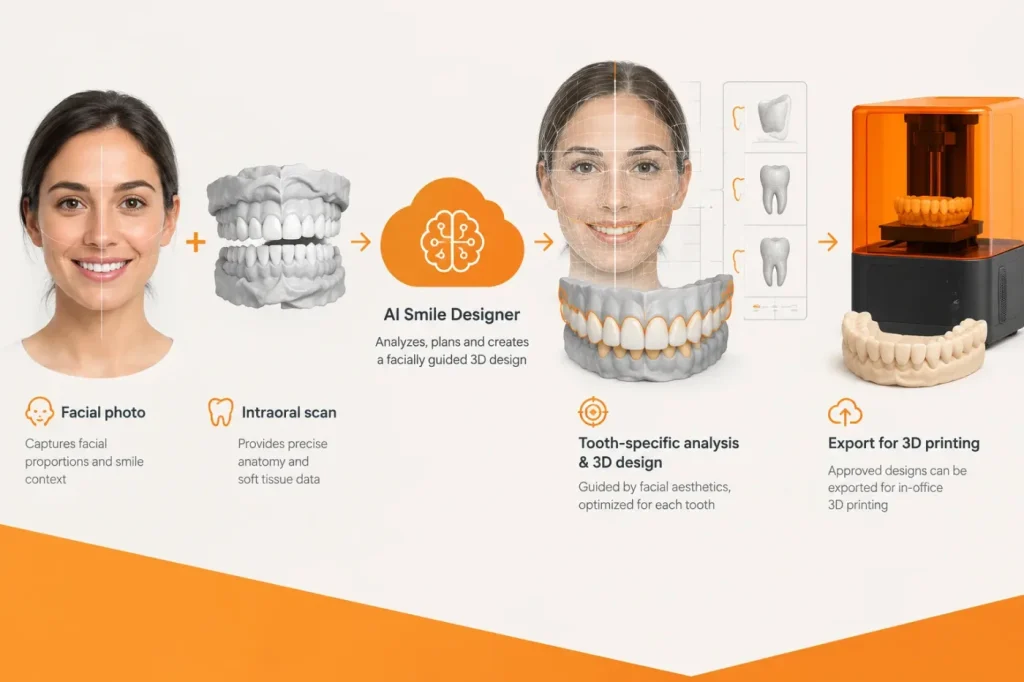

SmileFy’s new AI Smile Designer is intended to take a dental case from patient images to a facially guided 3D design, reducing the manual CAD work between analysis and a proposed treatment. In its original launch announcement, the company says the cloud-based tool uses a facial photograph and an intraoral (IO) scan to analyze the case, suggest tooth-specific treatment options and build a design directly on the scan.
From scan analysis to a printable design
The announced workflow begins with uploading a patient photo and IO scan. SmileFy says its AI evaluates more than a dozen facial, dental and gingival parameters, including facial symmetry, midline, facial thirds, smile arc, tooth proportions, axial angulation, alignment and gingival harmony. It identifies deviations and suggests target measurements, then generates tooth-specific treatment suggestions such as orthodontic alignment, enamel reshaping or composite and ceramic veneers. The release also says the workflow automates photo calibration and scan segmentation.
The key CAD step is that the resulting facially guided 3D design is created directly on the intraoral scan, rather than being limited to a photo-based visualization. The dentist can review the analysis, select a treatment approach and ask the AI Smile Assistant to refine tooth shape, position and proportion. SmileFy says dentists retain all clinical decision-making; the software performs the analysis and design work.
The company lists three intended outputs: a virtual mock-up shown on the patient’s face, approved designs for in-office 3D printing—including mock-ups, shells, wax-ups, temporaries and veneers—and shared facial references and design measurements for communication with a dental lab. SmileFy says the product is available now through a browser-based cloud platform accessible from modern web browsers, with no software installation or advanced CAD training required. The announcement does not name supported browsers or versions.
What the workflow change means
Connecting facial context to an IO scan could make the design more useful downstream than a standalone smile simulation: the announced workflow aims to carry analysis into a 3D design that can be prepared for printing. I would prioritize the scan-based design and its production handoff over the preview feature. The release says approved designs can be exported for in-office printing, so a practice should verify that the output fits its actual printer and lab workflow before relying on that handoff.
The release does not establish compatibility with particular scan or export file formats, printers, or other dental CAD systems. It describes approved designs as print-ready, but provides no independent performance evidence or comparative workflow timings. SmileFy’s claims that the software can reduce design fees, delays and appointments should therefore be treated as vendor claims, not established outcomes. And while the platform is described as accessible through modern web browsers, the announcement names no supported browser or version; practices should confirm that their chosen browser works with the cloud platform.
For practices considering adoption, I would require clinician review before any veneer design goes to production. A scan-based veneer could have inadequate clearance or an inaccurate margin if its geometry is not appropriate for the case; these are potential fit problems to check, not failures reported for SmileFy. Before production, the clinician should inspect the veneer’s margins and required clearance against the case and approve the design. The release says the dentist evaluates the findings and makes the treatment decisions, but does not describe a fit-validation step. I would not treat a generated design—or the label “print-ready”—as proof of fit without that clinical check.
Sources
- SmileFy Launches AI Smile Designer That Automates Smile Analysis and 3D Design — PR Newswire (release provided by SmileFy)
- SmileFy — SmileFy