
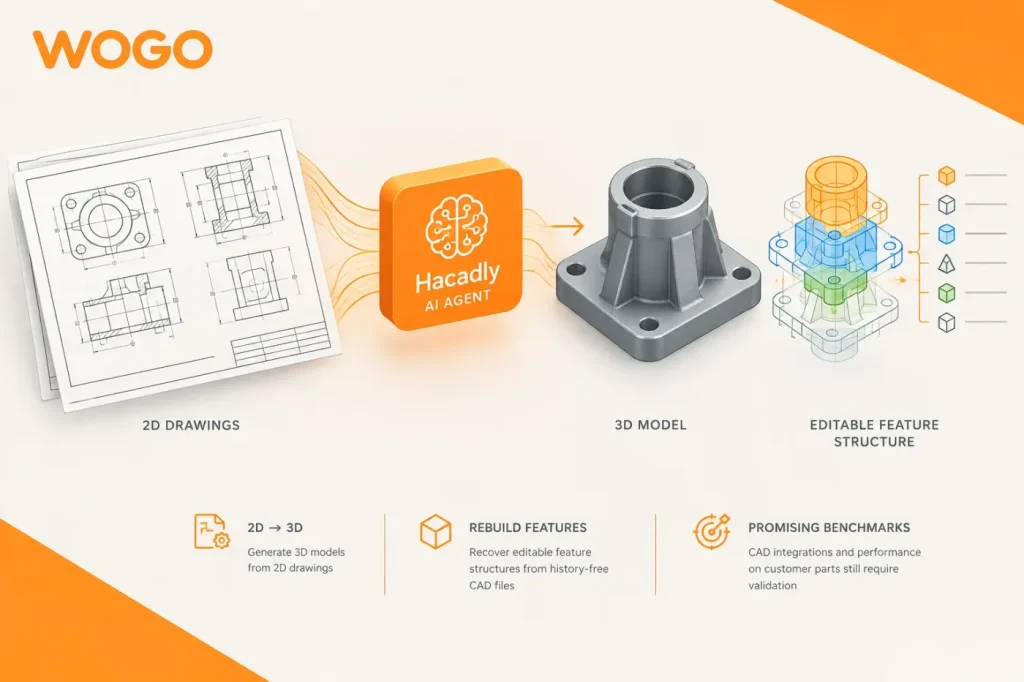

WOGO has launched Hacadly AI Agent, software designed to turn 2D mechanical drawings into 3D models and rebuild editable feature structures from history-free CAD data. The agent reads drawings or CAD data, then generates, checks and corrects models; WOGO describes the workflow in its launch announcement. The practical aim is to make old drawings and supplier files more usable for 3D design work, dimension changes and derivative parts.
From drawing views to STEP output
For drawing-to-model work, users provide a DXF or PDF drawing; WOGO recommends vector PDFs. Hacadly interprets geometry, dimensions and annotations across views, then produces a model in STEP format. The vendor says it can also restore feature attributes such as thread information. This could help teams that need to review or reuse 2D design records without manually rebuilding each part, although the release does not establish that the output is ready for manufacturing without engineering review.
WOGO reports that its internal test covered 23 drawings: nine sheet-metal parts, 10 machined parts and four fabricated parts. Hacadly passed the company’s geometry evaluation in all 23 cases, compared with 11 for a Claude system with tools and nine without. The success criterion checked for mismatches in the drawing’s outline, dimensions, holes and bends. These are WOGO’s results from a limited in-house benchmark; they do not establish accuracy across the range of drawings, conventions or part complexity found in production.
Rebuilding editability from history-free CAD
The second workflow targets 3D models without feature history, including STEP files. Hacadly creates a new feature structure—using elements such as sketches, extrusions, revolves and holes—so that parameters such as thickness, bend radius or hole diameter can be changed. WOGO explicitly says this does not recover the original designer’s operation history; it generates a new structure intended to make the shape editable.
For this workflow, WOGO tested 20 parts and reports exact shape reproduction for all 20, followed by 34 parameter-edit tests. Hacadly passed 33; the tool-connected Claude comparison passed 28 and the version without tools passed 20. WOGO says all comparisons used Claude Opus 5.5 and measured the complete systems, not the underlying language models alone. Feature reconstruction was evaluated in FreeCAD.
My inference is that reconstructed dependencies can fail even when the starting shape matches: a hole feature may depend on a face or reference that changes when plate thickness is edited, leaving the hole misplaced or preventing downstream features from rebuilding. I would use the 33-of-34 result as a reason to run a focused pilot, not as proof that the workflow suits a design team. On representative files, I would change thickness and then test required hole-diameter and hole-position edits, checking that dependent features rebuild and the resulting dimensions and shape match the intended design. Any required edit that fails or displaces a dependent feature is a rejection for that file.
Integration and deployment questions remain
WOGO says Hacadly is installed on user devices and connected to the customer’s CAD environment as an add-in. It also offers a configuration that connects to a customer-managed cloud AI environment, in which case, according to the company, data does not pass through WOGO’s servers. The announcement does not name a standard list of supported CAD systems or prices: CAD integration is arranged to suit the environment, and both pricing and supported environments require an inquiry. The announced availability date is November 5, 2026.
My inference is that a separate integration risk is losing access to the reconstructed feature tree when moving the model into the target CAD system: a STEP shape may transfer without providing the editable structure the workflow is meant to create. I would test a representative reconstructed model in the target application and check that its feature tree is present and that required features can be selected, edited and recomputed there. My acceptance rule is to proceed only if the target system exposes a usable feature tree for the team’s required edits; a shape-only STEP transfer does not pass when editability is required. WOGO says it plans to expand supported CAD environments, part types and assemblies, but those are future plans rather than current capabilities confirmed in the launch details.