
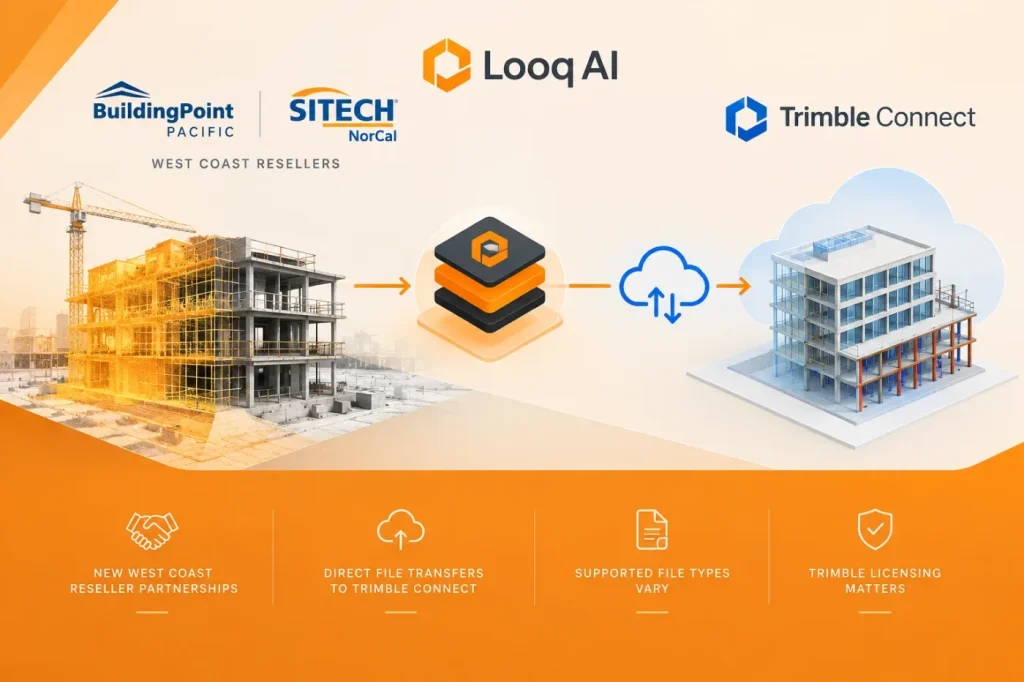

Looq AI is widening access to its handheld reality-capture platform through reseller agreements with BuildingPoint Pacific and SITECH NorCal, while also demonstrating direct file transfers to Trimble Connect. The announcement links regional sales coverage with a more direct route for moving processed capture outputs into Trimble’s project environment—a practical change for survey and infrastructure teams already using Trimble software.
BuildingPoint Pacific is authorized to distribute Trimble products in California, Oregon and Washington; SITECH NorCal is a Trimble dealer serving Northern California, Oregon and Southern Washington. The agreements expand Looq’s route to customers through established regional providers. The announcement does not specify exclusivity, pricing, or changes to Looq’s product packaging, so the confirmed development is distribution access rather than a newly announced capture capability.
File transfer helps, but does not erase workflow boundaries
Looq combines handheld 3D imaging and ground-based photogrammetry to produce point clouds and orthomosaic imagery. The company describes its platform as pairing the qCam, a handheld photogrammetric camera with built-in survey-grade GNSS and an onboard AI processor, with qAI cloud processing and the qApp web application. Its qSurvey tool drafts CAD-ready linework for topographic, linear, overhead and underground surveys. Looq says its platform already works with Trimble Business Center (TBC) and that it demonstrated direct transfers to Trimble Connect. The announcement gives no TBC or Connect version requirements, and a demonstrated transfer does not prove every output becomes a fully usable, viewable or editable Connect object.
Looq’s support documentation describes exports of point clouds as LAZ, embedded-pano point clouds as E57, orthos as TIFF and tracks as GeoJSON. It also says users need a Trimble ID with access to the destination project and permission to add files. Some outputs—including panorama folders and processing reports—are not sent through this export route. The documentation notes that opening point clouds in Trimble Connect requires Trimble’s Reality Capture add-on.
I would not count a direct transfer as a workflow gain until the team confirms that the files it relies on are included and the required Connect licensing is in place. Looq’s guide excludes panorama folders and processing reports, and the Reality Capture add-on is required to open point clouds in Connect; either constraint could erase the benefit of skipping a download-and-upload step. My adoption test is to transfer a representative project, verify each required output in the destination folder, and confirm that the intended users can open the point cloud with their current licenses.
Teams should also confirm that their installed TBC version accepts the exported formats and that the Connect project’s folder permissions are in place. The announcement reports TBC compatibility but does not specify a supported host version, so version compatibility remains a check for each deployment.
Regional access is the more immediate change
I see the reseller agreements as improving regional access, not as confirmation of support commitments. BuildingPoint Pacific covers California, Oregon and Washington, while SITECH NorCal serves Northern California, Oregon and Southern Washington; the announcement does not specify training or support-response commitments. That leaves a practical risk: without a defined support-escalation route, a team facing a problem that needs further assistance could lose time working out whom to contact, delaying project work. My reseller-selection rule is to choose a provider only after it confirms in writing that it serves the project location and identifies the training, purchasing and support-escalation arrangements available to that team.
Looq cites customer outcomes, including AJ Surveying’s reported 60% faster turnaround and 43% lower survey costs on topographic data for underground utility projects. The announcement also says McElhanney used Looq to capture four downtown areas in approximately four hours following the 2024 Jasper wildfire, supporting Parks Canada’s property-boundary restoration work. These are vendor-reported examples, not independent performance benchmarks; results will depend on project conditions and deliverables. The company’s claim of up to 10× faster field capture should likewise be treated as a vendor claim rather than a guaranteed project-wide time saving.
For current Trimble users, the concrete workflow question is whether the supported exports, required licenses and installed host versions fit their project setup. The new partners broaden the channel for exploring that fit, while the Connect handoff offers a more direct transfer path whose practical value depends on the files and downstream tasks a team needs.
Sources
- Looq AI, BuildingPoint Pacific, and SITECH NorCal Expand Reality Capture Across the West Coast — Business Wire
- Export to Trimble Connect — Looq AI Support