
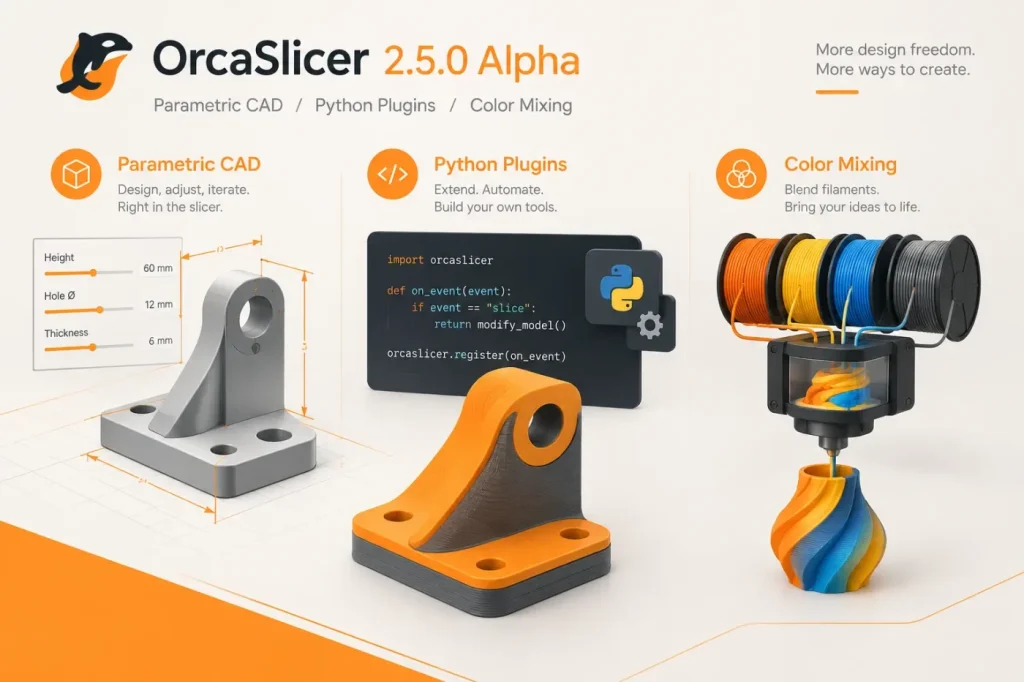

OrcaSlicer is bringing parametric part design and Python extensions into its 3D-printing workflow, alongside filament color mixing. The project introduced the changes in its OrcaSlicer 2.5.0 Alpha release, a testing build that also added belt printing and parallel printing for IDEX and IQEX machines. If the Design tab works as documented, users can keep simple part design and print preparation in one application instead of switching between a slicer and separate CAD software.
The project’s documentation describes the experimental Design tab as a sketch-first parametric CAD environment: users can sketch, constrain geometry, build solids and send them to the build plate. Unlike an imported mesh, the documented model is a feature recipe that can be replayed after edits, with the recipe saved in the 3MF project. That could make straightforward, dimension-driven modifications more convenient inside the slicer. It does not establish that the feature replaces a dedicated CAD system for complex modeling or engineering requirements.
My view is that the Design tab is the most important workflow change in the release, but its practical value depends on editability and handoff. The documentation says the parametric recipe is retained in 3MF; my decision rule is whether the intended recipient can reopen the project and revise that recipe. If the workflow depends on CAD interchange or collaboration beyond that, 3MF retention alone is not evidence that the handoff is covered.
The new Python plug-in system is aimed at customization rather than geometry alone. According to the release notes, plug-ins can add one-click actions, modify layers or G-code during slicing, add interface panels and respond to events. Users can install them from a file or through Orca Cloud. The project says plug-ins must request permission before accessing the network, launching other programs or reaching beyond OrcaSlicer’s data folder. But the API is new and may change, so teams building tools around it should expect to revisit compatibility as development continues.
Color mixing combines two or three loaded filaments of the same type, according to the alpha notes. The announcement does not, by itself, establish how accurately a given combination will reproduce a target color or a complete set of printer requirements. For a production workflow, those results still need to be checked with the relevant filaments and machine rather than assumed from a screen preview.
The alpha also bundled Texture Displacement, support for printing two to four parts at once on IDEX and IQEX machines, and support for the Bambu Lab H2C and A2L. The release description says the build drew on more than 950 pull requests from over 140 contributors, while warning that features were experimental and could change. Alpha builds can contain bugs, and features may change or disappear; treat this as an evaluation build, not a production reliability signal.
After the alpha, OrcaSlicer published a beta on October 27 and a release candidate on November 1. The release candidate still describes the Design tab as experimental, while presenting 2.5.0 as nearly ready. For users considering the new CAD and plug-in workflows, the current release candidate is therefore a more relevant evaluation point than the original alpha. I would not make an essential plug-in a production dependency until its required action—such as modifying layers or G-code—has been confirmed on the exact build selected and its permission requests fit the team’s policy. If either check fails or remains unresolved, postpone deployment.
Sources
- OrcaSlicer V2.5.0 Alpha release — OrcaSlicer on GitHub
- Design Tab — OrcaSlicer Wiki
- OrcaSlicer V2.5.0 Beta and RC release notes — OrcaSlicer on GitHub