
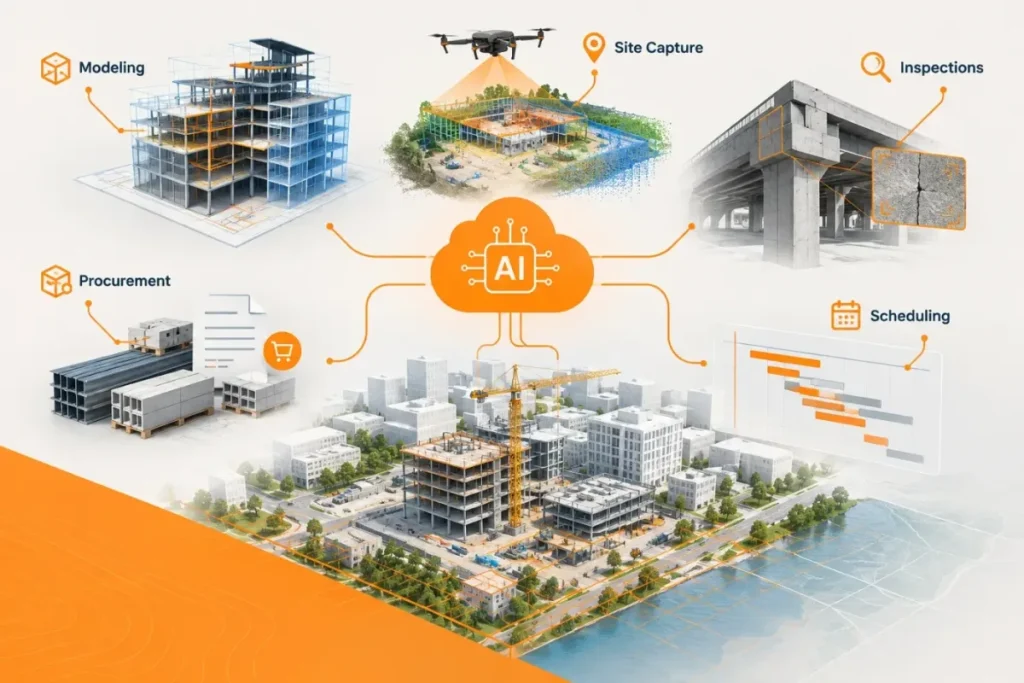

Trimble is adding AI features across design, field and financial workflows in Trimble Connect, including a scheduling tool that links a master timeline with project information such as RFIs, weather and field look-aheads. The company’s announcement describes the platform expansion; a separate release details Trimble Connect Scheduling. Trimble says several capabilities are available now, but others are restricted or still being developed.
Trimble Assist provides a conversational interface for engaging with agents and insights across the Trimble ecosystem, while Agent Studio lets customers configure and govern specialized agents using their procedures and institutional knowledge. Trimble Connect links design, estimating, field and financial information and works alongside enterprise systems, according to the company. These are vendor descriptions, not independent evidence of improved project outcomes.
Scheduling connects plans with changing site information
Trimble Connect Scheduling connects a master schedule to live project data, including field look-aheads, RFIs, weather forecasts, daily reports and submittals. Its agentic planning engine evaluates risk and suggests actions such as optimizing float or resequencing activities. Teams review and approve suggested schedule adjustments, according to Trimble, rather than the system applying them without approval.
Contractors can create schedules in the product or import schedules from Primavera P6, Microsoft Project and other tools. Trimble says imports preserve schedule logic and baselines. The company also says its planning model was trained on construction project data and can compare current conditions with historical operational patterns. These are product claims; the release does not provide comparative accuracy results.
I would treat Scheduling initially as a risk-detection and planning aid, not an autonomous schedule manager. The reported review-and-approval step means teams remain responsible for deciding whether recommendations fit contract commitments and field constraints. In a pilot, compare imported schedule logic and baselines with the source and confirm that linked project information is current; do not rely on recommendations until both checks pass. The product is available in North America to general contractors and subcontractors across construction sectors.
Availability differs across the AI features
Trimble lists Automated Structural Modeling, One-Click AI Indoor Classification, 360 Reality Capture, AI Punch Walk, AI Procurement and Invoice Matching, and Connect Scheduling as available capabilities. The workflows range from generating constructible steel models and classifying point-cloud scans to linking spoken inspection observations to drawings and comparing invoices with purchase orders and delivery receipts.
Other announced functions have narrower status. AI Diagnostics for Field Hardware is available to select customers; Generative Design is in Trimble Labs, an early-engagement program; and Design File Verification and Change Order Automation are in development. The staged rollout is important for adoption decisions: capabilities described in the same platform announcement are not necessarily ready for general production use.
Trimble also says all currently available agents and models in Connect’s AI layer have standardized safety labels covering safety, security design and data provenance, which it characterizes as aligned with the EU AI Act, ISO 42001 and its AI Statement and Principles. That describes the vendor’s governance approach; the announcement does not independently establish the quality or effect of the individual AI outputs.
I would not rely on 360 Reality Capture for site decisions until its point clouds have been checked against surveyed control points. Misaligned point clouds could place site conditions in the wrong position relative to project drawings and lead teams to make decisions based on an inaccurate view of the site. Trimble says the tool aligns video-derived point clouds with project drawings, so verify that alignment against surveyed control points before relying on the output.