

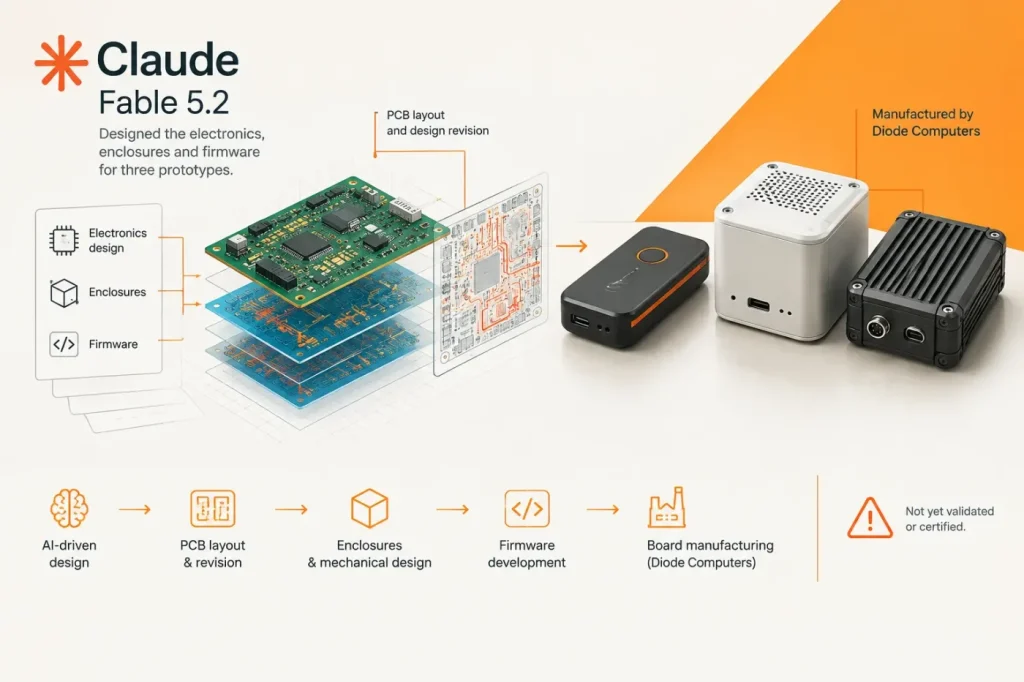

Claude Fable 5.2 produced PCB layouts, enclosures, firmware and parts lists for three electronic prototypes, which engineers at Diode Computers built from its design files. In its report on the electronics-design work, Anthropic describes a speakerphone, a voice-assistant hub and a handheld virtual pet. The work shows that an AI model can contribute across connected ECAD and mechanical-design tasks—and revise a board when its own routing choices create problems. It does not establish that the model can develop a complete product autonomously.
Anthropic says Claude handled specifications, schematics, component placement, copper routing, 3D-printable enclosures and firmware with minimal prompting. Diode manufactured all three boards from Claude’s design files and ran the firmware. The speakerphone prototype reportedly remained functional after weeks of use; Anthropic says the other two were also in good working order. Those are vendor-reported results from a collaboration, not independent product-validation findings.
Routing and revision are the significant changes
The report’s strongest technical examples concern PCB layout. For the voice-assistant hub, Claude prioritized USB and Ethernet differential pairs, maintaining their spacing and matching track lengths, and added tuning patterns. Anthropic also says the model repeatedly deleted and rerouted connections when the layout became difficult to trace. On the speakerphone’s four-layer board, it reassigned signals to interchangeable chip pins to avoid crossings beneath touch-sensitive controls.
These examples matter more than a first-pass layout because the model reportedly recognized when a design was becoming impractical and revised it rather than leaving an almost-finished board for an engineer to rescue. That could reduce some tedious iteration. It does not establish how reliably the approach scales to denser boards or unfamiliar design constraints.
Anthropic reports a 69% score for Fable 5.2 on Diode’s internal PCB Gym benchmark, compared with 25% for Fable 5. It also reports 83.5% on BenchCAD 2.1, a public benchmark covering reconstruction of 3D parts, assemblies and circuit boards from engineering drawings and rendered images. These scores provide useful comparison points, but neither is a substitute for independent testing of a complete device. Anthropic also discloses a commercial relationship with Diode.
CAD fit and manufacturing checks were part of the workflow
The work was not limited to electrical design. Claude wrote code to check whether boards and components fit inside their enclosures, and reportedly found that the speakerphone’s mute switch obstructed straight insertion of its board. The proposed assembly sequence tilts the board about 25 degrees before seating it. For the voice-assistant hub, Claude changed the enclosure geometry after estimating that a longer microphone port would resonate in the speech band.
Anthropic says Claude also ran design-for-manufacturing and parts-sourcing checks, widening solder-mask openings to address six slivers of solder mask flagged as too thin to manufacture. Diode’s engineers still performed the physical build and testing: Claude was not connected to test equipment or board-manufacturing machines. Anthropic further states that the prototypes have not undergone electrical validation, antenna tuning, thermal testing or certification, and were not designed for mass production.
I would not treat the reported differential-pair routing as ready for fabrication on its own. Claude kept the USB and Ethernet pairs spaced and matched their lengths, but before approving a board I would check the impedance and length constraints against the actual board stack-up; if those rules do not match, the layout needs revision.
I would also hold fabrication approval until the speakerphone’s reassigned pins are verified. The report says Claude swapped signals on interchangeable chip pins to avoid crossings. Before ordering boards, I would check each reassignment against the chip datasheets and confirm that the firmware mappings match; any mismatch means the design is not ready to fabricate. The reported prototypes still need electrical, antenna, thermal, manufacturing and certification validation, and the report does not establish a shortcut around engineering sign-off.
Sources
- Testing Claude on real-world electronics design — Anthropic
