
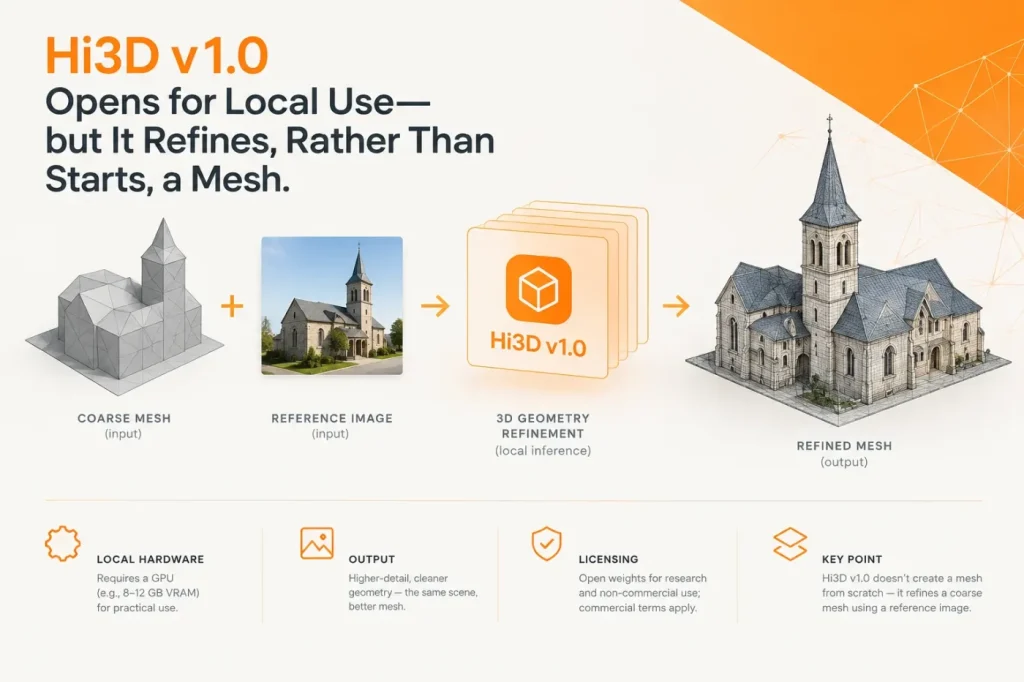

Hi3D has made its v1.0 geometry-refinement model available with inference code and weights, opening a route to run the technology locally or integrate it into a custom pipeline. But it is not, by itself, an image-to-mesh generator: the standard refinement workflow takes both a coarse mesh and a reference image of the same object, while the API also supports existing voxel coordinates as geometry input. The original GitHub release describes the mesh-based workflow, while the repository documentation describes Hi3D v1.0 as a refinement pipeline built on Sparc3D.
The model progressively refines geometry at nominal sparse extraction-grid resolutions of 512³, 1024³ or 1536³. Hi3D says its training used about two million curated 3D assets. These figures describe the refinement pipeline and its sparse grid; 1536³ is not a promise of a particular polygon count or guaranteed downstream accuracy.
A refinement stage, not a complete modeling workflow
Developers can supply an existing mesh from another generator or their own workflow, then use Hi3D to add geometry informed by the reference image. The repository includes an optional Hunyuan3D-2 mini example for producing a coarse mesh, but Hi3D says this is not a core dependency; its refinement demo can instead take a user-supplied mesh. Hi3D can serve as one stage in a larger pipeline, while upstream modeling remains the responsibility of other tools or workflows.
Output limitations are equally significant. The inference code exports a geometry-only mesh; it does not generate textures, materials or vertex colors. It also recenters and normalizes output to unit maximum radius, so the input’s absolute scale and world coordinates are not preserved. A separate check or downstream step is therefore needed before treating a result as dimensionally meaningful or sending it directly into a manufacturing workflow. The project documentation further cautions that errors in the coarse structure can persist and that unseen surfaces are plausible completions, not verified reconstructions.
My view is that the coarse-mesh requirement is the release’s most important practical detail. The release warns that errors in the coarse structure can persist. For example, a refined mesh may retain a misplaced mating hole from its coarse input. Before accepting a result for engineering use, I would compare the hole’s position with the design tolerance; if it falls outside that tolerance, I would reject the mesh or correct it before use. I would also compare the refined result against the original mesh and reference image, then verify scale, critical dimensions and printability in the receiving tools. Fine surface detail alone is not enough.
Local deployment has specific constraints
The published setup calls for Linux, Python 3.10, an NVIDIA GPU with compute capability 8.0 or newer, and a compatible CUDA toolkit in the 12.0–12.5 range; the repository says there is no CPU inference path. Hi3D reports validating the 1536³ pipeline on a 96 GB NVIDIA H20 and says feasibility on smaller cards has not been established. Sequential CPU offload is offered to reduce GPU model residency, but the documentation does not present it as proof that lower-memory hardware can run the full pipeline.
Normalization can disrupt assembly alignment. Because the output is recentered and normalized to unit maximum radius, it may no longer share the coordinate frame of other parts. I would retain the input transform and check landmark registration against the other parts before accepting the output. If the landmarks do not register in the shared frame, I would restore the transform or re-register the mesh before using it in the assembly.
Teams should also note that “open source” does not mean unrestricted use under a conventional permissive license. The repository says the Hi3D Open License Agreement governs specified Hi3D-owned or authorized materials. Among its stated conditions, commercial integrations must display “Powered by Hi3D 1.0,” and products or services reaching specified scale thresholds must seek a separate written license. Third-party components retain their own terms. Teams considering deployment should review the agreement’s scope and the applicable third-party licenses before integrating or redistributing the model.
For developers with suitable NVIDIA hardware and an existing image-to-mesh workflow, Hi3D v1.0 provides code and weights to evaluate a high-resolution refinement stage. Its announced resolution is a starting point for testing—not a substitute for checking the mesh’s dimensions, topology, appearance and suitability in the intended application.