
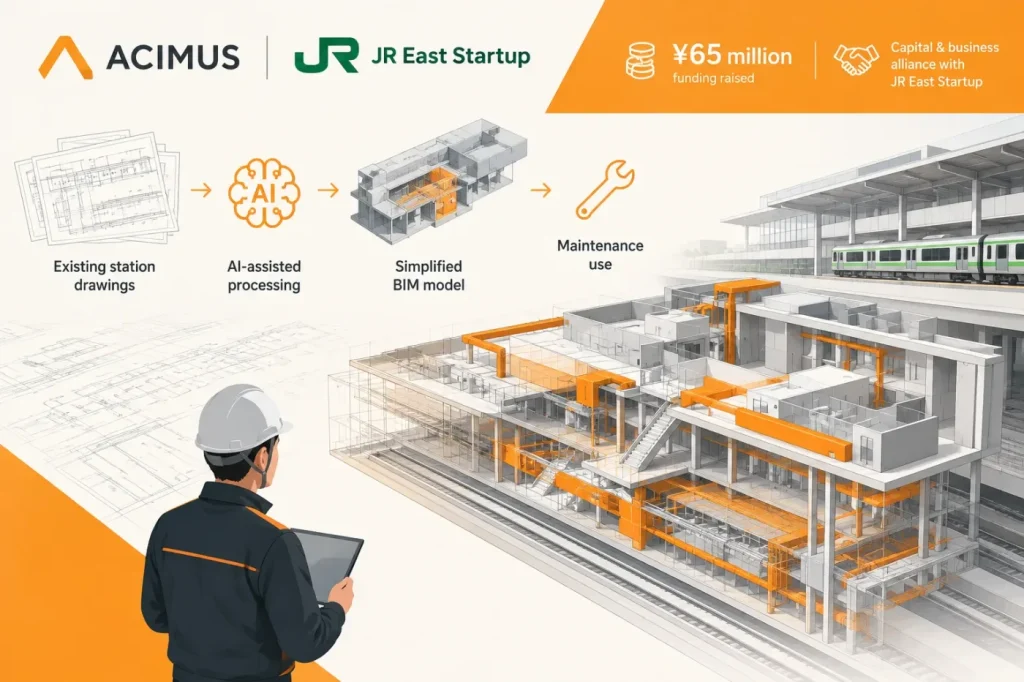

ACIMUS has raised approximately ¥65 million in seed funding and agreed a capital and business alliance with JR East Startup, linking development of its browser-based, AI-assisted BIM service to a practical challenge: creating models of existing station buildings from drawings. In its funding announcement, ACIMUS says the money will support expansion of the station-modeling verification, early-design features, and transition from trials to full deployment.
Link Capital led the round, with Incubate Fund and JR East Startup also participating. Separately, JR East Startup’s announcement of the alliance says the companies tested creation of simplified BIM models for maintenance from existing station drawings. JR East Startup reports that manual modeling of a small station building typically took about 95–100 hours. The companies say their trial showed potential to reduce that effort substantially, but neither release gives a measured post-trial modeling time.
From natural-language instructions to an IFC handoff
ACIMUS lets users create and edit building BIM models through everyday-language instructions in a web browser. The company says model components—including columns, walls and floors—carry attribute information, and that users can export the result in IFC for transfer to existing BIM software. That positions the service as an entry point for early planning and volume studies, as well as a way to turn legacy drawings into simplified models for maintenance. The announcements do not identify supported browser requirements, receiving-software products or versions, or report round-trip interoperability results.
A simplified model derived from station drawings is for its stated maintenance scope; it is not automatically a detailed design or construction model. ACIMUS describes the station output as simplified, and the reported trial is evidence of a workflow being tested—not proof that every building type, drawing condition or downstream use is covered. The company says verification will expand to other stations. The source excerpt reports that JR East has approximately 1,680 station buildings and about 24,000 buildings including related facilities, making the scope of any wider verification consequential.
I would assess this workflow by checking the model after IFC handoff, not by prompt-to-model speed alone. The useful test is whether the simplified, drawing-derived model preserves the component attributes that a maintenance team needs in its chosen BIM platform. The announcements establish that IFC export is supported, but do not report round-trip interoperability results or quantify the time saved in the station trial.
My inference from the station trial is that simplification creates a coverage trade-off: a model may take less effort to create yet omit detail or attributes needed for a particular maintenance task. I would accept it for a defined maintenance use only after confirming that every component and attribute required for that use is present in the IFC model; otherwise, it is not a validated substitute, regardless of the time spent creating it.
Funding backs both existing-building and design workflows
ACIMUS says it will also use the funding to develop ACIMUS KIWARI, a design AI that generates multiple BIM proposals from given conditions, and to build structural and regulatory checks intended to speed early design decisions. The company began a preliminary verification program for KIWARI in June 2026; the new release describes further development, not general availability of those planned functions. ACIMUS says its main service launched in 2025 and that trials are underway at construction companies and design offices. The source excerpt also says Japan’s Ministry of Land, Infrastructure, Transport and Tourism began “BIM drawing review” in April 2026, using documents and 3D models exported from BIM for building confirmation; it does not establish that ACIMUS output has been used in that process.
The service’s stated IFC handoff and station-drawing trial make it relevant to existing CAD and BIM workflows, but do not demonstrate a replacement for established authoring tools. My recommendation is to time the complete drawing-to-validated-model workflow across stations and compare it with the 95–100-hour manual baseline, including correction time. The comparison should also confirm that the resulting models retain the attributes needed for their intended maintenance use. The next meaningful evidence will be whether expanded station tests produce repeatable reductions in modeling effort across stations while delivering models with attributes that remain useful in maintenance workflows.
Sources
- ACIMUS raises approximately ¥65 million and announces alliance with JR East Startup — ACIMUS / PR TIMES
- JR East Startup and ACIMUS agree capital and business alliance — JR East Startup / PR TIMES