
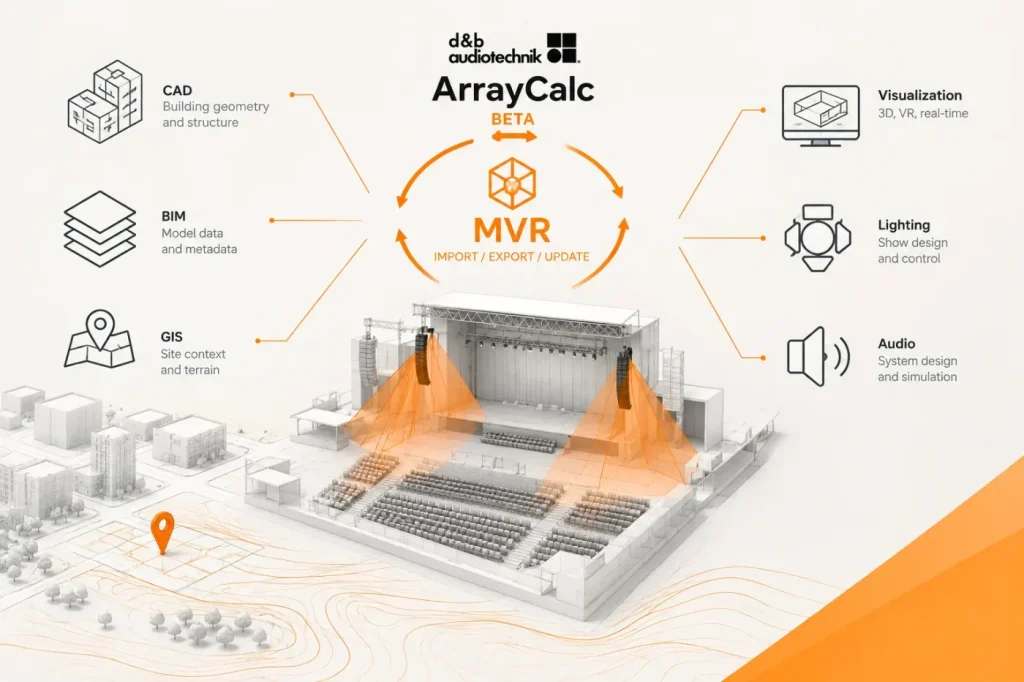

d&b audiotechnik has added MVR Exchange to the ArrayCalc beta, allowing users to import, export and update venue and loudspeaker-system data through the open MVR format. The change connects d&b’s audio-planning workflow with compatible CAD, lighting and visualization applications. The company outlined the feature in its original announcement.
A shared project model for production teams
MVR, or My Virtual Rig, is an open DIN standard for exchanging production information across disciplines. With the new feature, ArrayCalc can bring in venue models from external applications, send sound-system designs back into the production workflow and exchange updates as a project develops. d&b says the format covers venue geometry, staging and lighting as well as loudspeaker-system data.
The intended benefit is less repeated model creation and data entry when audio, lighting and venue teams work on the same production. Exported loudspeaker information can also be viewed in CAD environments for coordination tasks such as sightline checks, collision detection and project documentation. These are use cases described by d&b.
The vendor identifies an MVR import-and-export dialogue, a new “Background” element type and optimized venue performance among the feature’s additions. Its MVR Exchange page says the feature is available through the d&b Beta Program. Teams should confirm that their particular tools can exchange the project data they need.
Coordination depends on usable exchanged data
For audio planners, importing venue geometry could reduce the need to rebuild a space before placing and evaluating a system. Sending the loudspeaker design back out gives other departments a way to coordinate against the proposed system rather than relying only on separate drawings or manual handoffs. Because the workflow includes updates, it also offers a route for keeping exchanged project information aligned as plans change.
I see the strongest practical value in that update loop, not in one-time model transfer. But sharing a file format does not, by itself, establish that every application will interpret each project element in the same way or that exchanged information is current. Before relying on it for coordination, I would check a representative project in both directions: confirm that relevant venue and loudspeaker elements arrive as expected, then repeat the exchange after a design change.
MVR Exchange is available through d&b’s Beta Program, so teams can evaluate the workflow there. It provides a standards-based exchange path in ArrayCalc; users should treat application compatibility and project-data checks as part of adoption.
A separate coordination risk is that teams could work from different project states—for example, a CAD view based on an earlier venue model while audio planning has moved on. I would not accept an exchanged model for coordination unless the team can identify it as the current project revision and confirm that its venue geometry and loudspeaker layout reflect the latest approved changes; otherwise, I would keep it out of coordination drawings until the mismatch is reconciled.
Sources
- d&b integrates MVR Exchange into ArrayCalc (original announcement) — d&b audiotechnik
- MVR Exchange for ArrayCalc — d&b audiotechnik
- ArrayCalc — d&b audiotechnik