
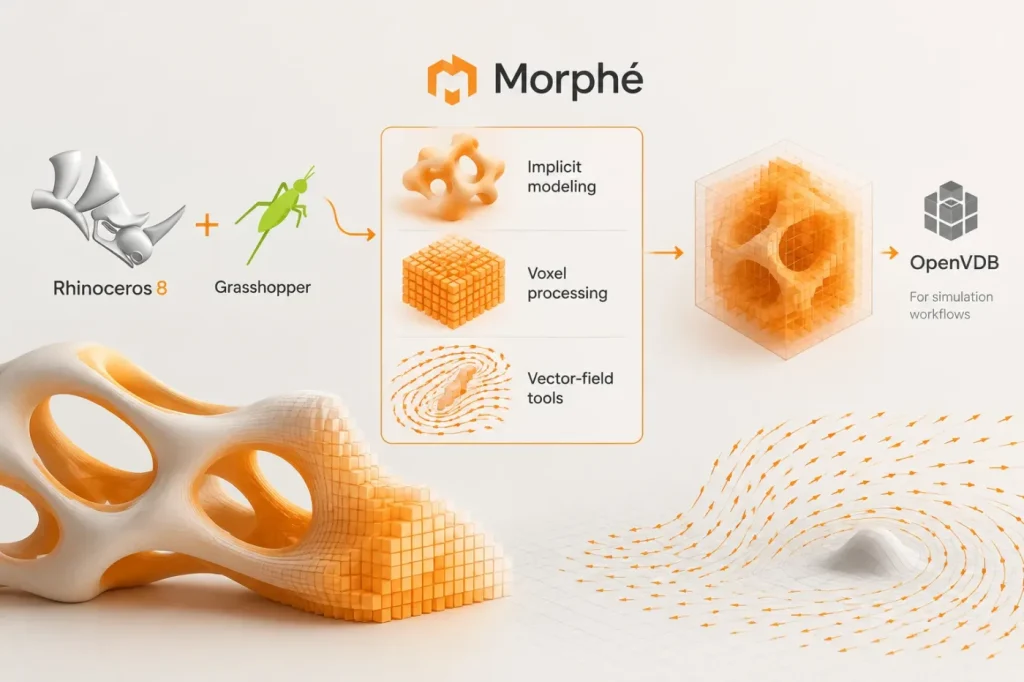

Metamorphic AM’s Morphé launch announcement introduces a Rhino 8 plug-in that combines implicit modeling, voxel processing and vector-field tools inside Grasshopper. Its stated aim is to let designers create and revise complex geometry while keeping it connected to the parametric definition that generated it.
The plug-in targets forms such as lattices, branched channels and parts with locally varying wall thicknesses—geometry that can be cumbersome to develop and revise through conventional surface or mesh workflows. Metamorphic says Morphé’s implicit engine supports unions, intersections, shells, offsets, blends and lofts. Structures can be built from curves, surfaces or formulas, then varied across a part or conformed to curved surfaces.
Three representations in one definition
Morphé pairs implicit modeling with a voxel engine for smoothing, reworking and repairing mesh or scan data, including conversion into watertight solids. Its vector-field tools can use simulation or measurement data to influence geometry or parameters; the company names stress, temperature, pressure, density and flow as possible inputs. The launch materials describe these capabilities working together in a single Grasshopper graph, alongside GPU-accelerated previews, sectional views and regional cropping.
Inference: This combination could reduce the need to move a design into a separate geometry tool and rebuild or reconnect its logic after a change. I would retain the combined workflow only if a representative geometry change requires fewer edits and reconnections than the team’s current process. The launch materials do not establish that every downstream edit remains associative.
The announcement also describes an OpenVDB export intended for a Morphé-to-ChopMesh workflow with Voxshell, producing volumetric meshes for computational fluid dynamics and finite element analysis without an STL-repair step. Metamorphic says a live demonstrator is planned for Formnext 2026. Before relying on that handoff, users should check the resulting mesh quality and whether the receiving workflow suits their solver and analysis requirements; OpenVDB export alone does not establish simulation readiness.
What is—and is not—specified
The stated host requirement is Rhino 8; the announcement does not identify support for earlier versions. It provides no computation-time figures, maximum model sizes or quantified performance figures for GPU previews. Without those figures, engineering teams cannot judge how practical Morphé will be for dense lattices or large volumetric inputs, where resolution and resource demands can affect workflow viability.
My adoption decision would turn on a representative part combining a parametric lattice, scanned or meshed input, and simulation-driven variation. I would compare the edits and reconnections required after a geometry change with the team’s current process, then check whether the exported volume meets the downstream solver’s needs and how the results compare with current repair and conversion steps. Until those checks are possible, Morphé is best understood as a promising integration of tools—not proof that geometry-to-simulation handoffs are frictionless.
Sources
- Metamorphic AM launches Morphé to bring advanced implicit and voxel-based modelling into Grasshopper — Engineering Update
- Morphé expands Grasshopper with implicit modeling for 3D printing — 3Druck.com
- Morphé: Metamorphic AM wants complex 3D printed shapes to stay “alive” inside Grasshopper — 3D ADEPT Media